

GoHighLevel vs Salesforce is a comparison between two very different ideas of what a CRM should be. Salesforce is the biggest name in the category: IDC's April 2026 software tracker gave it a 20.0% share of the worldwide CRM market for 2025, its 13th straight year at number one, according to Salesforce's own IDC ranking announcement. GoHighLevel is the all-in-one platform agencies and service businesses use to run CRM, funnels, SMS, and booking under one flat fee.
Size alone does not settle the choice. A ten-person sales team selling six-figure contracts and a marketing agency managing thirty local clients need different things from a CRM platform. In this GoHighLevel vs Salesforce comparison, we look at pricing, CRM depth, marketing automation, AI, reporting, integration options, and day-to-day fit, with real 2026 prices from both vendors, so you can pick the tool that matches how your business actually makes money.
Quick Verdict: GoHighLevel vs Salesforce
Choose GoHighLevel if you are an agency or service business that needs CRM, funnels, SMS, calendars, and reputation management in one platform, with unlimited users and the option to resell it under your own brand. Choose Salesforce if you run a dedicated sales team with complex deals, need deep customization, territory management, and enterprise reporting, and have the budget for per-user pricing plus separate marketing tools.
| Factor | GoHighLevel | Salesforce |
|---|---|---|
| Pricing model | Flat $97, $297, or $497 per month | Per user per month: $25 to $550 on Sales Cloud |
| Users | Unlimited users on every plan | Every user is a paid seat |
| Marketing automation | Email, SMS, and workflows included | Basic email on Starter; Marketing Cloud Next from $1,500 per org per month |
| SMS and calling | Native two-way SMS and phone | Not part of Sales Cloud; SMS sits in Marketing Cloud Next Advanced |
| Funnels and booking | Built in on every plan | Needs other products, add-ons, or apps |
| Customization | Practical: custom fields, objects, pipelines | Deep: custom objects, Flow, Apex, permissions |
| Resell / white label | Sub-accounts, white label, and SaaS Mode | No agency resell model |
| Best for | Agencies and service businesses | Sales-led B2B and enterprise teams |
GoHighLevel and Salesforce at a Glance
Before comparing features, it helps to know what each product is trying to be. The two platforms grew from opposite ends of the market, and that history still shapes how they price, what they include, and who they serve best.
What GoHighLevel Is: One Platform for Agencies
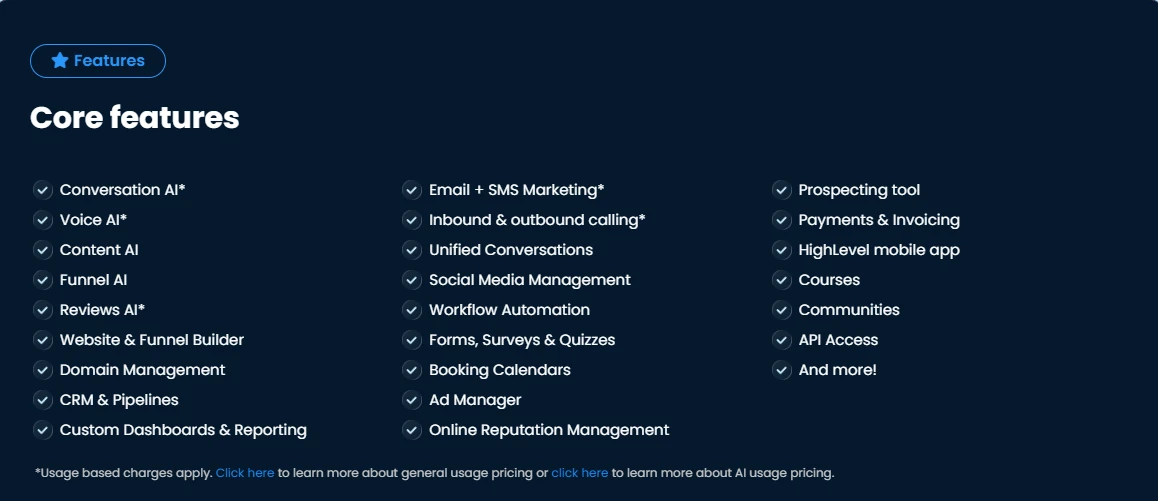
GoHighLevel, often shortened to GHL, is an all-in-one sales and marketing platform built specifically for marketing agencies. One account bundles a CRM and pipelines, a website and funnel builder, email and SMS marketing, two-way calling, booking calendars, reputation management, courses, communities, and AI tools. Agencies run each client in its own sub-account, so a GHL agency can manage dozens of businesses from one login. Our guide on what GoHighLevel is covers the platform in more depth.
What Salesforce Is
Salesforce is an enterprise CRM platform made of separate clouds. Sales Cloud runs the pipeline and the sales team, Service Cloud runs support, Marketing Cloud runs campaigns and messaging, and dozens of other products sit around them. Everything shares one data model that admins and developers can customize almost without limit, which is why large companies with complex processes build on it. The trade-off is that each cloud is priced and licensed on its own, so the full Salesforce stack is assembled, not bought in one box.
GoHighLevel vs Salesforce Pricing Comparison: Flat Fee or Per User?
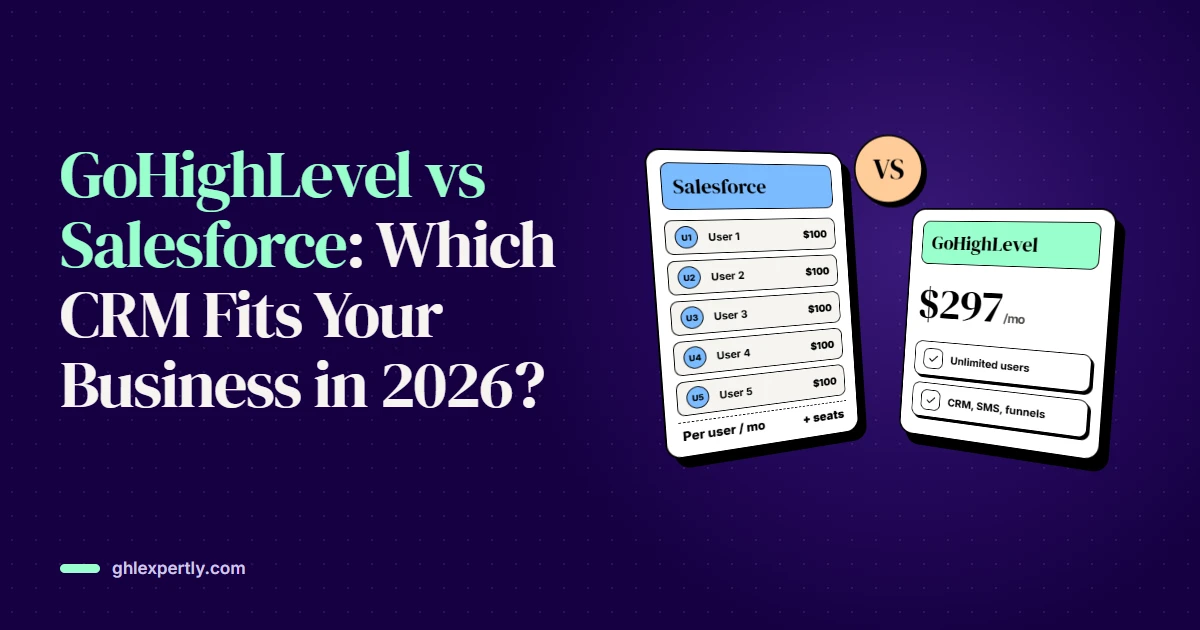
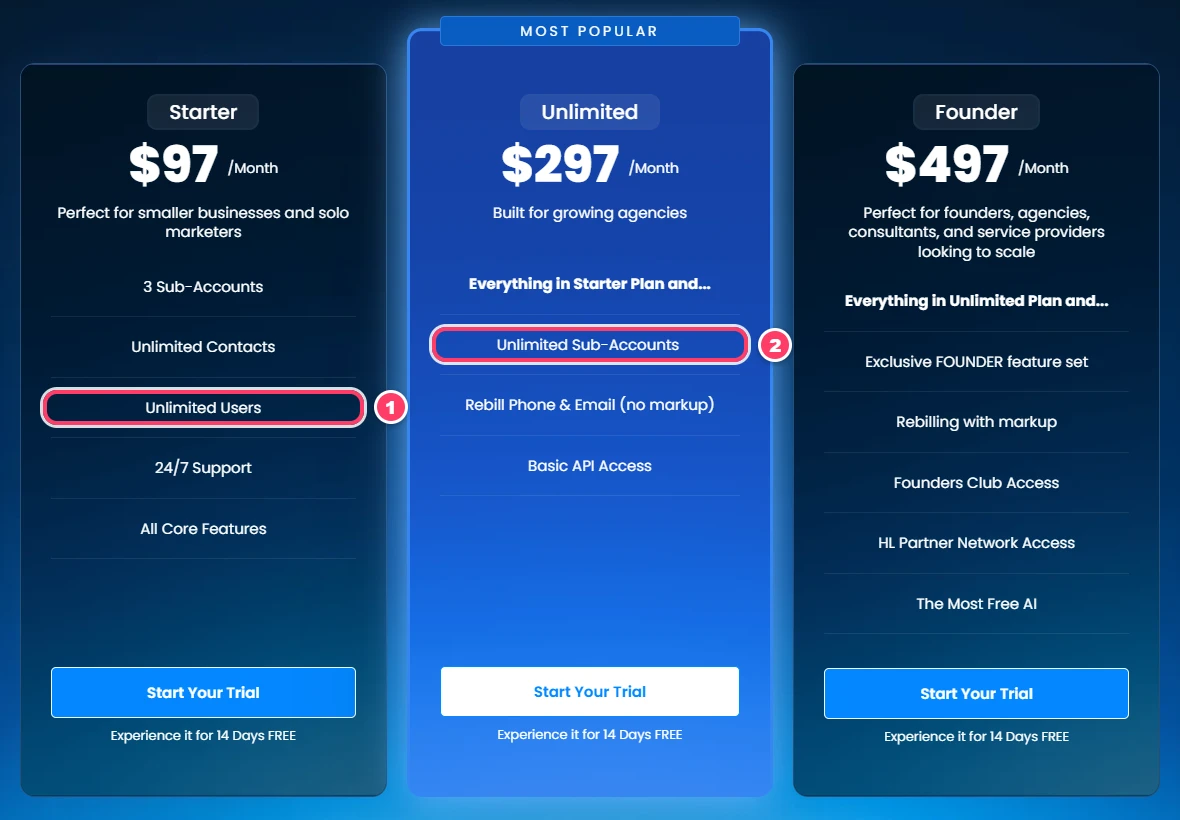
The pricing model is the biggest practical difference between GoHighLevel and Salesforce. GoHighLevel charges one flat monthly fee. Starter costs $97 per month with up to three sub-accounts, Unlimited costs $297 per month with unlimited sub-accounts, and the $497 plan, which HighLevel now lists as Founder and many agencies still call Agency Pro, adds rebilling and SaaS Mode for reselling. HighLevel's pricing page lists unlimited contacts and unlimited users on every plan, so adding a new hire never changes the bill.
Salesforce prices per user per month, and each product is licensed separately: Salesforce pricing starts at $25 per user per month on Starter Suite. Marketing tools are a separate line item: Salesforce Starter includes basic email marketing, but full marketing automation means Marketing Cloud. The Marketing Cloud pricing page lists Marketing Cloud Next Growth at $1,500 per org per month and the Advanced edition, which adds SMS and WhatsApp, at $3,250 per org per month, both billed annually.
Salesforce Sales Cloud Editions in 2026
Salesforce's Sales Cloud pricing page lists five paid editions. Starter can be billed monthly or annually; the others are billed annually, and Salesforce notes that prices are subject to change.
- Starter Suite, $25 per user per month: Lead, account, contact, and opportunity management, built-in sales flows, email and calendar sync, and basic email marketing.
- Pro Suite, $100 per user per month: Adds more customization and automation, quoting, and forecasting.
- Core, $195 per user per month: Everything in Professional Edition plus Premier Success, Slack, and Tableau Next. Salesforce says AI can be added from Core upward.
- Advanced, $395 per user per month: Adds enhanced security, more AI, larger data capacity, and backup tools.
- Max, $550 per user per month: The full AI suite, including Agentforce for Sales, plus Salesforce Maps and sales planning.
A Total Cost Comparison for a Small Team
Take a ten-person team that needs a CRM, a sales pipeline, and email plus SMS follow-up. On GoHighLevel, the Starter plan covers all ten users for $97 per month, or $297 per month on Unlimited if you manage several client accounts. That is the whole platform fee before SMS and call usage.
On Salesforce, ten seats cost $250 per month on Starter Suite, $1,000 per month on Pro Suite, or $1,950 per month on Core. Sales Cloud pricing lists no SMS feature, so a team that needs texting is looking at Marketing Cloud Next Advanced at $3,250 per month on top, or a third-party SMS app from the marketplace. The extra cost grows with every user you add.
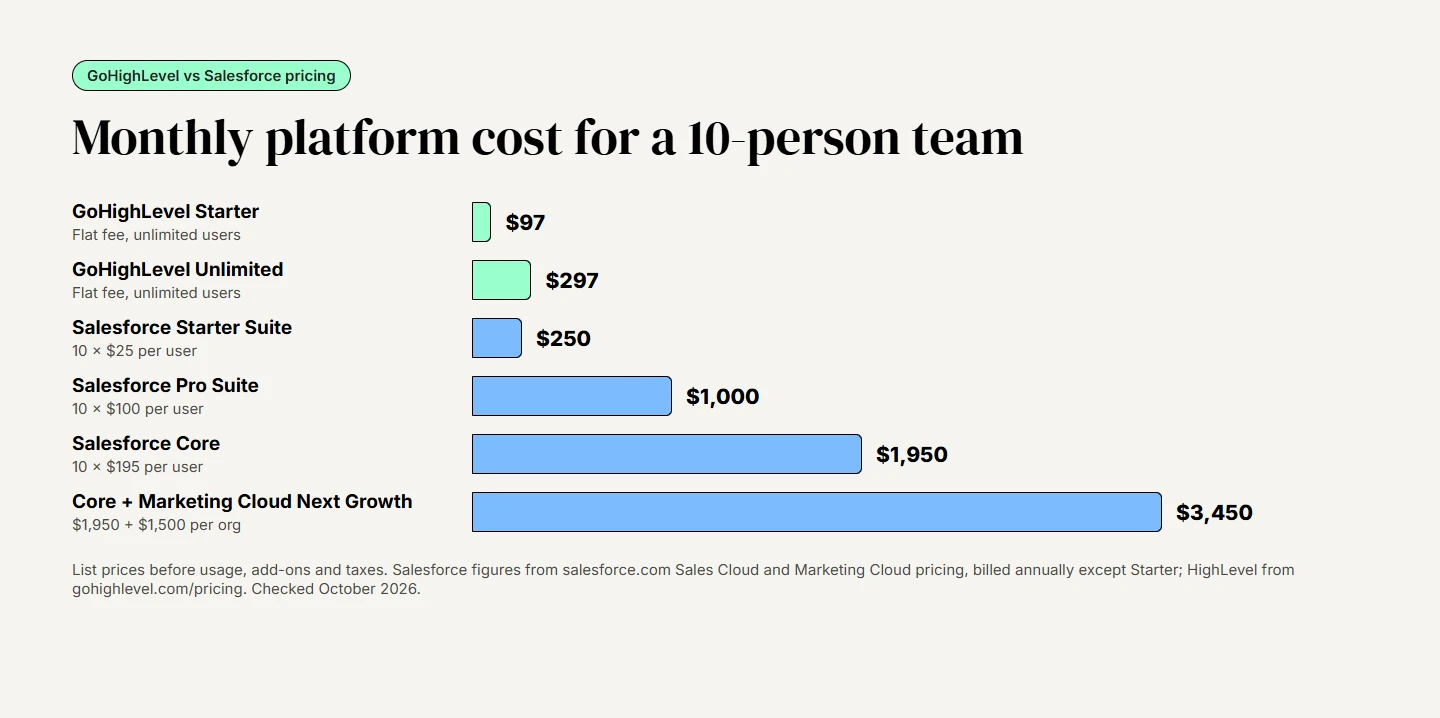
Bottom line: for a small team that needs marketing and sales in one place, the Salesforce stack typically costs several times more than GoHighLevel before implementation. Salesforce earns that premium only when you use the depth it adds.
Hidden Fees and Extra Cost on Both Sides
GoHighLevel bills usage separately: SMS, phone minutes, email sends, and AI features run on a wallet, so high-volume texting raises the monthly total. Our GoHighLevel pricing guide breaks those fees down. Salesforce adds cost through extra seats, paid add-ons for AI and premium support, implementation partners, and annual contracts that lock in the seat count. Salesforce also notes that transaction fees apply on Starter, and every additional cost is billed per user or per org. On both platforms, budget for setup time or expert help; a rushed build costs more than either subscription.
Sales and Marketing Features Compared Side by Side
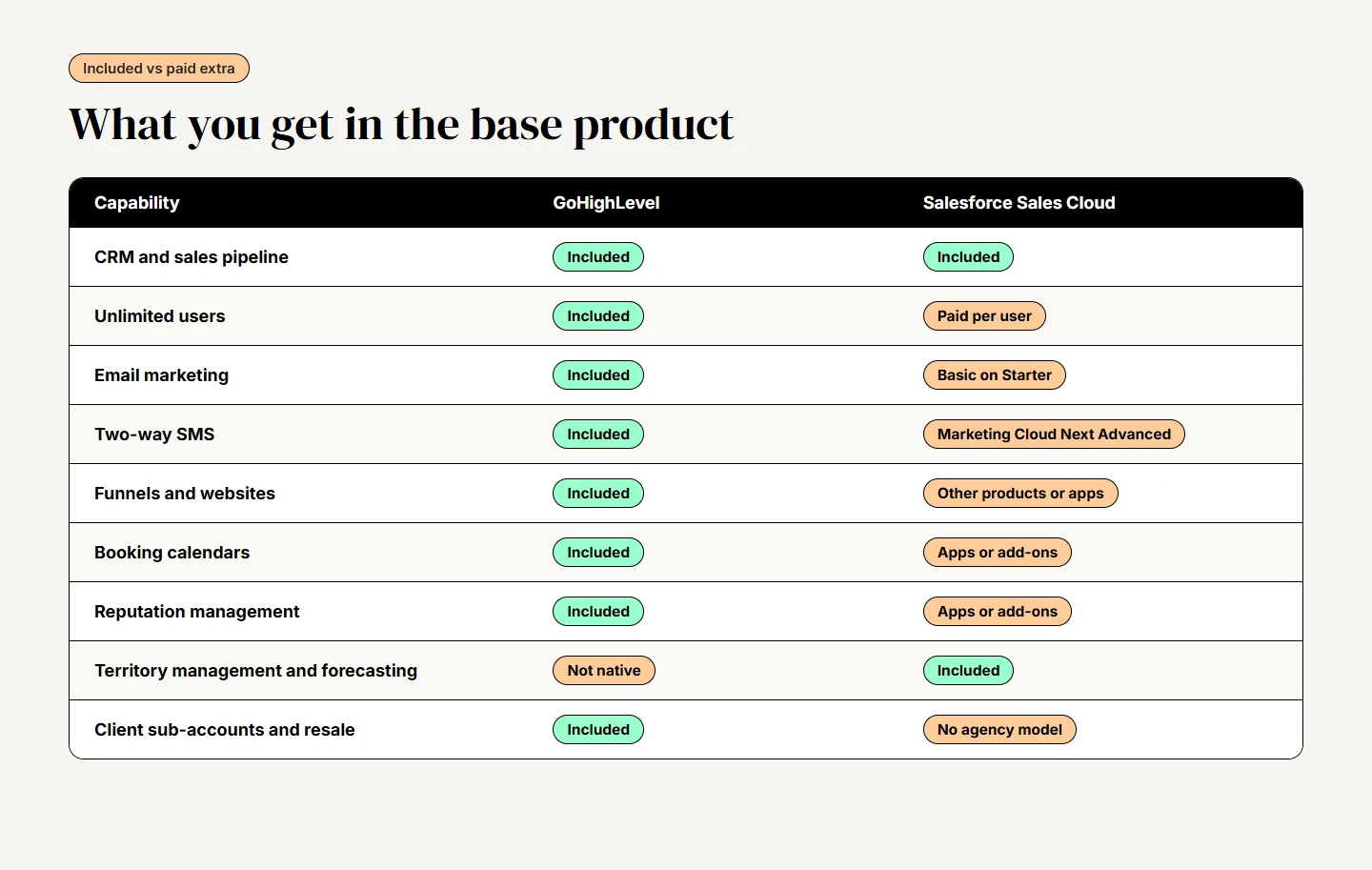
The clearest way to compare GoHighLevel with Salesforce is to look at what ships in the base product and what you pay extra for. GoHighLevel includes most marketing and client-facing tools on every plan. Sales Cloud includes a stronger core CRM but leaves messaging, pages, and booking to other products.
CRM Depth and Customization
Salesforce is an enterprise CRM with deep customization. Custom objects, custom fields on everything, validation rules, granular permissions, territory management, forecasting, and quoting let a sales team model almost any process. Flow and Apex code take it further, which is why large companies build entire operations on the platform.
GoHighLevel is a practical CRM built around speed to lead. Contacts, tags, smart lists, and drag-and-drop pipelines cover what most agencies and local businesses need, and custom objects are now available for teams that track more than contacts and deals. It does not match Salesforce on complex permissions, territory rules, or multi-currency forecasting. Our GoHighLevel CRM guide walks through what the CRM does well.
Bottom line: if your sales team needs heavy customization and governance, Salesforce wins. If you need a basic CRM that captures leads and moves them through a pipeline fast, GoHighLevel does it with far less setup.
Marketing Automation, SMS, Workflow, and Booking Tools
This is where GoHighLevel pulls ahead for most small and mid-size businesses. Email marketing, SMS marketing, two-way texting, missed-call text back, calendars, booking pages, review requests, and reputation management all ship on every plan. GoHighLevel workflows can trigger a text, an email, a pipeline move, or an AI reply from one builder, and our workflow automation guide shows 15 real use cases.
Salesforce splits marketing and sales into separate products. Sales Cloud handles the pipeline and sales team, while Marketing Cloud handles campaigns, journeys, and mobile messaging at its own price. The result is powerful at scale but needs more tools, more budget, and usually an admin or partner to connect everything.
Funnels and pages follow the same pattern. GoHighLevel includes a funnel and website builder tied directly to the CRM, so a sales funnel, its form, and its follow-up all live in one place, much like a ClickFunnels-style builder with a CRM attached. Salesforce relies on Marketing Cloud, Experience Cloud, or third-party builders for landing pages.
Reporting and Analytics
Salesforce reporting is built for sales leaders. Report builders, dashboards, forecasting, and pipeline analytics come standard, and Core and higher editions bundle Tableau Next for deeper analysis. Revenue operations teams that report to a board or a CFO get more structure here than from any agency tool.
GoHighLevel reporting is built for operators and agencies. Custom dashboards track pipeline value, appointments, calls, ad results, and conversations per sub-account, so an agency can show each client what its marketing produced. It answers how many leads came in and what happened next well, but it is not designed for multi-touch attribution across a large sales organization.
AI Features: Agentforce vs GoHighLevel AI
Both platforms now lead with AI, but they package it differently. Salesforce sells AI as an upgrade: its pricing page says AI can be added from Core upward, and the full AI suite, including Agentforce for Sales, comes with the $550 Max edition. The focus is on helping sales reps research accounts, draft outreach, and work the pipeline.
GoHighLevel puts AI tools inside every plan and bills the heavier ones by usage. Conversation AI replies to SMS and chat, Voice AI answers calls and books appointments, and Content AI, Funnel AI, and Reviews AI handle copy, pages, and review replies. Our AI Employee guide covers plans and setup. For a local business, an AI that answers missed calls and books jobs usually pays back faster than an AI that summarizes a large account.
Ease of Use: Setting Up a GoHighLevel Account vs Salesforce
GoHighLevel is faster to launch for a small team. A new GoHighLevel account opens with every tool switched on, most of the platform is drag-and-drop, and agencies can load ready-made snapshots with pipelines, workflows, and funnels already built, then adjust branding instead of starting from zero. The learning curve is real, because the platform does so much, but a working system can go live in days.
Salesforce is a project. Even Starter needs fields, stages, and users configured, and anything beyond the basics usually involves an admin, a consultant, or an implementation partner. That effort buys flexibility, but teams without a dedicated owner often end up using a small part of what they pay for.
Integration and Ecosystem: How to Integrate GoHighLevel with Salesforce
Salesforce has the larger ecosystem. The Salesforce AppExchange marketplace, which Salesforce folded into a unified AgentExchange marketplace in 2026 (covered in this SalesforceBen report), lists thousands of apps and consulting partners, and most enterprise software ships a Salesforce connector first.
GoHighLevel covers the agency and local business stack natively and connects to everything else through its marketplace, Zapier, webhooks, and an open API. Running Salesforce and GoHighLevel together is common: many teams keep Salesforce as the system of record for the sales team and use GoHighLevel for lead capture, SMS follow-up, and booking, syncing contacts between the two.
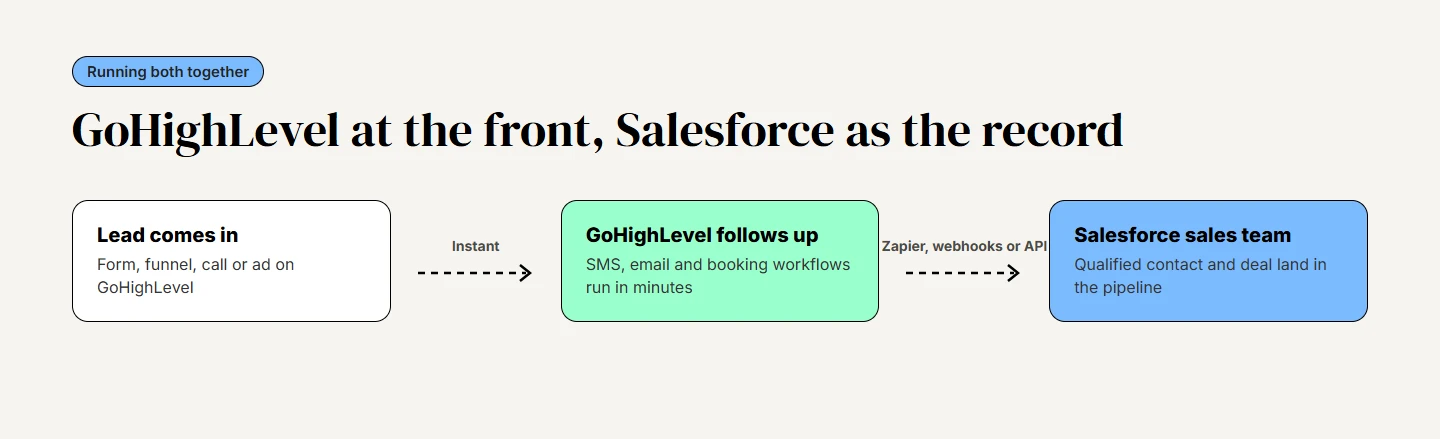
If you need a custom sync with field mapping or two-way updates, a GoHighLevel developer can build it on the API.
GoHighLevel vs Salesforce Pros and Cons
Neither tool is weak. They are built for different operators, and the gap shows up in daily use more than on a feature checklist.
GoHighLevel Pros and Cons
- Pro: one platform: CRM, funnels, email, SMS, calendars, reviews, and courses in one account replace four to six separate subscriptions.
- Pro: unlimited users: No per-seat pricing, so growing the team or giving clients logins does not add cost.
- Pro: sub-accounts and resale: Agencies give every client an isolated sub-account and can rebrand and resell the platform through SaaS Mode.
- Con: usage fees: SMS, calls, email, and AI are billed on top of the plan, so heavy messaging raises the monthly cost.
- Con: lighter sales management: No native territory management and simpler forecasting than an enterprise CRM.
Salesforce Pros and Cons
- Pro: customization: Custom objects, Flow, Apex, and granular permissions let large teams model complex sales processes.
- Pro: sales management: Territory management, forecasting, quoting, and pipeline reporting built for sales leaders.
- Pro: ecosystem: The largest CRM marketplace and partner network, with connectors for most enterprise systems.
- Con: per-user pricing: Every seat is billed, and higher editions require annual contracts.
- Con: separate marketing products: SMS, journeys, and advanced campaigns live in Marketing Cloud at its own price, plus setup work to connect it.
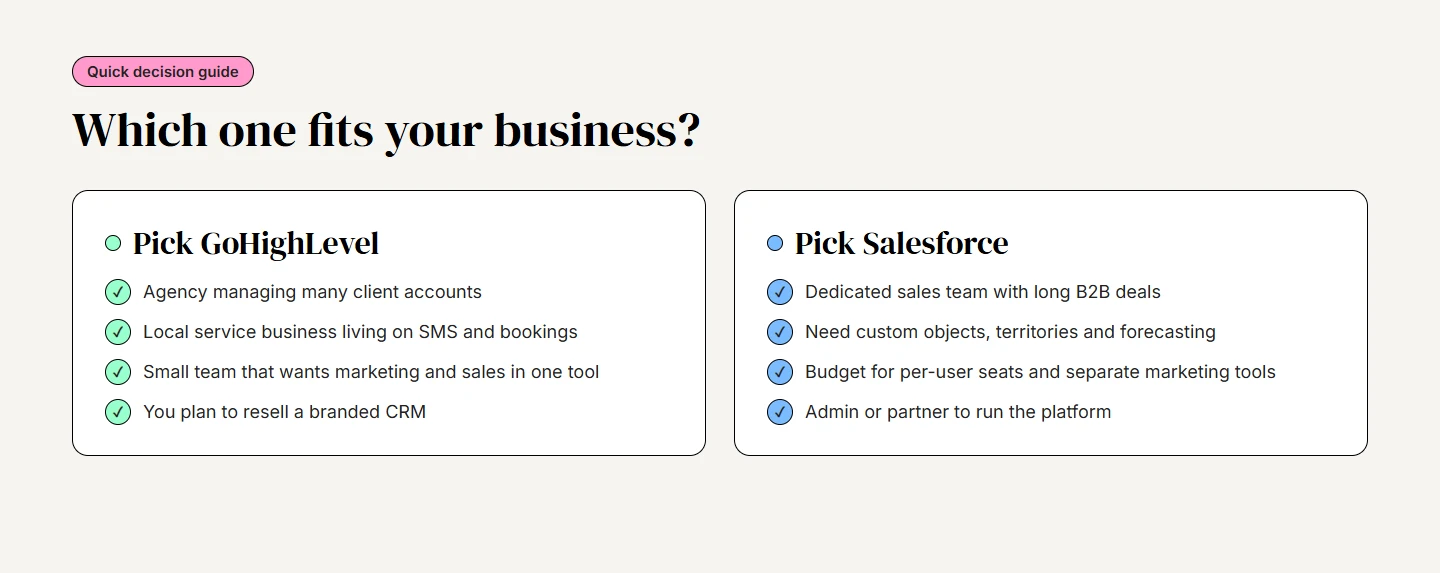
Who Should Choose GoHighLevel or Salesforce?
Marketing Agencies That Resell Client Systems
Digital marketing agencies should default to GoHighLevel. Sub-accounts, snapshots, white label, and flat pricing match how agencies and service businesses deliver work across many clients. Salesforce has no equivalent multi-client model for agencies, so you would be paying per user for every client team.
Local Service Businesses
Dentists, med spas, contractors, and other local businesses win with GoHighLevel. Native SMS, booking, review requests, and missed-call text-back drive revenue directly, and a dental practice snapshot can have the system running in days. Salesforce is far more platform than these businesses need.
B2B Sales Teams
A B2B company with a dedicated sales team, long deal cycles, and many stakeholders per deal fits Salesforce. Pipeline governance, forecasting, and reporting justify the per-user cost when deals are large. A small team selling simpler offers will usually get more value from GoHighLevel.
Enterprise Organizations
Salesforce enterprise customers with an existing stack, internal admins, and integrations to ERP and data systems should stay on Salesforce and its higher editions. GoHighLevel can still sit alongside it for local marketing, SMS, or franchise locations, but it is not a replacement for a dedicated Salesforce deployment at that scale.
Switching from Salesforce to GoHighLevel
Teams that outgrow the cost of Salesforce, or never used most of it, often move their marketing and pipeline into GoHighLevel. A clean move follows the same steps every time.
- Export contacts, accounts, and open opportunities from Salesforce as CSV files, with owners and stages.
- Map Salesforce fields to GoHighLevel custom fields and pipeline stages before importing anything.
- Import contacts with tags that record their source, then rebuild open deals in the matching pipeline.
- Register your business for SMS before sending texts, and connect email sending domains.
- Rebuild key automations as GoHighLevel workflows, or start from a snapshot and adjust it.
- Run both systems side by side for a few weeks, then switch the team over once reports match.
Moving years of custom objects and integrations is harder. If your Salesforce org carries custom code or ERP links, bring in GoHighLevel specialists to plan the migration so nothing is lost.
Things to Consider Before You Compare GoHighLevel and Salesforce
- How you sell: Fast, high-volume lead follow-up favors GoHighLevel. Long, multi-step B2B deals favor Salesforce.
- Team size and growth: Count future users, not just today's. Per-user pricing compounds; a flat fee does not.
- Marketing and sales in one tool: If marketing and automation must live next to the pipeline, check what each Salesforce product costs together.
- Admin capacity: Salesforce usually needs an admin or partner. GoHighLevel can be run by a small team, though expert setup still pays off.
- Reselling plans: If you want to resell software to clients, only GoHighLevel offers sub-accounts and SaaS Mode.
Where HubSpot Fits in Salesforce vs GoHighLevel
Many buyers shortlist HubSpot as a third option, and it sits between the two. Like Salesforce, it charges per seat and splits marketing, sales, and service into separate hubs. Like GoHighLevel, it is easier to set up than Salesforce and bundles email marketing with the CRM. It still has no agency sub-account or resell model, so for agencies the choice usually comes back to GoHighLevel. Our HubSpot comparison covers that matchup in full.
Which Should You Pick for Your Business Needs?
Pick GoHighLevel if you are an agency, a local service business, or a small team that needs CRM, marketing tools, SMS, and booking on one platform at a flat price. You can test it on the 14-day trial; our free trial guide covers what to set up first.
Pick Salesforce if you run a sales-led business with a growing sales team, complex deals, and the budget and admin support for per-user pricing and separate marketing products. Still weighing other tools? Our ClickFunnels comparison and list of GoHighLevel alternatives cover the rest of the field.
Concluding Remarks on GoHighLevel vs Salesforce
Salesforce is the stronger enterprise CRM, with customization, sales management, and an ecosystem few platforms match. GoHighLevel is the stronger all-in-one platform for agencies and service businesses that want marketing automation, SMS, funnels, and booking without paying per user.
Match the platform to your business needs first, then compare features. If you want a second opinion on your setup, book a call with our GoHighLevel experts and get a clear build plan before you commit to either platform.
Frequently Asked Questions About GoHighLevel vs Salesforce
Is GoHighLevel cheaper than Salesforce?
For most small teams, yes. GoHighLevel costs a flat $97, $297, or $497 per month with unlimited users, plus usage fees for SMS and calls. Salesforce Sales Cloud runs from $25 to $550 per user per month, and full marketing automation through Marketing Cloud Next starts at $1,500 per org per month.
Can GoHighLevel replace Salesforce?
For agencies, local businesses, and small sales teams, GoHighLevel can replace Salesforce and the marketing tools around it. For enterprise sales teams that depend on custom objects, territory management, forecasting, and deep integrations, Salesforce remains the better fit.
Can you integrate GoHighLevel and Salesforce?
Yes. Teams connect the two through Zapier, webhooks, or the GoHighLevel API, often using GoHighLevel for lead capture, SMS, and booking while Salesforce stays the system of record for the sales team.
Does Salesforce include SMS marketing?
Not in Sales Cloud. On Salesforce's Marketing Cloud pricing page, SMS and WhatsApp messaging are listed in Marketing Cloud Next Advanced, which costs $3,250 per org per month billed annually. GoHighLevel includes two-way SMS on every plan, with messages billed as usage.
Which is better for marketing agencies, GoHighLevel or Salesforce?
GoHighLevel. It was built for agencies, with sub-accounts for every client, snapshots, white label, and SaaS Mode for reselling. Salesforce has no comparable multi-client model and charges for every user.
Does Salesforce have AI like GoHighLevel?
Yes, but it is priced as an upgrade. Salesforce says AI can be added from the Core edition upward, and the full AI suite with Agentforce for Sales comes with the Max edition at $550 per user per month. GoHighLevel includes Conversation AI, Voice AI, and Content AI on every plan, with usage-based charges for the heavier tools.